
The Grounded Diagnostic
Where you stand, proven — not estimated.
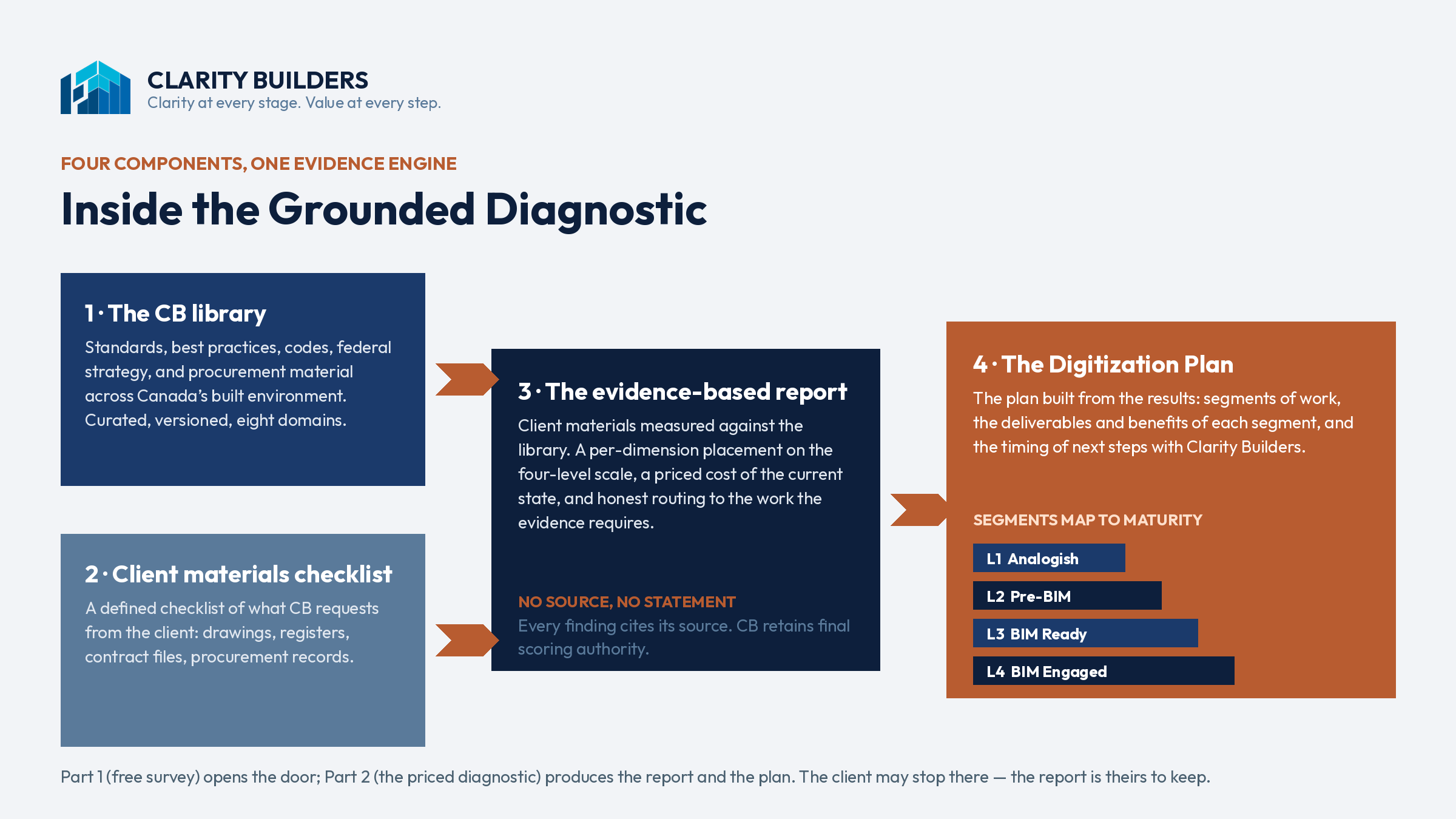
Every maturity finding, every cost-of-current-state figure and every recommendation is backed by a traceable, citable source. It produces insights organizations can confidently made decisions on.
The design decision
Why "grounded". There are many good reasons why the diagnostic is called that.
Most maturity assessments ask you how you think you're doing. This one is different. It is scored against a project you have actually completed — the project most likely to hold the artefacts, documents and delivery experience that 43 segments need in order to be evidenced.
All of your data is then uniquely vetted ensuring its validity and integrity. Then, your data is then measured against hundreds of relevant standards, best practices, policies and more that have been pulled - based on your specific profile - from our Dynamic Library. The resulting scorecard and Digitalization Plan are grounded throughout in accuracy and evidence.
Scoring discipline
Four rules that never bend
| Rule | What it means for you |
|---|---|
| No source, no statement | Every score our system makes and every corrective action carries a citation from your data. A finding that cannot be sourced is not issued — it is not softened into a qualified observation. Your confidence comes from knowing results are grounded in evidence. |
| Mandatory is a floor, not a ladder | In advancing your organization, meeting a mandatory requirement is a compliance check. It never raises a maturity score on its own. A fully code-compliant organization can still be Analogish because we view being compliant as something you would expect. |
| The gate cap always wins | The goal is to advance your maturity level, say Analogish in Contracts to pre BIM. Your level is the lowest of the evidence-implied level, the gated level and the completeness cap. Ticking minor items cannot out-score a threshold that is not evidenced. Translation > our system makes you earn any advancement in maturity. |
| AI drafts, Clarity Builders decides | This is important for us to share and something we are transparent about. Artificial intelligence assists the analysis, some of it quite unique. But people make the judgement, and Clarity Builders retains final scoring authority through the Grounded Diagnostic and in measuring progress in the Clarity Compass program. |
We sell AI governance. Running unsupervised scoring internally would not survive a single procurement question — which is why the internal rule and the client service say exactly the same thing.
What happens, and what we need from you
Six milestones
| Milestone | What we need from you | What you get |
|---|---|---|
| 1 · Kickoff and scoping | Complete the intake form, join the scoping call, confirm what applies to you | Your confirmed scope and requirement set |
| 2 · Evidence and interviews | Documents against our request, and people available for 60-minute conversations | A logged, hashed evidence base |
| 3 · Completeness check | Confirm we have everything you hold in the areas we asked about | Nothing scored as absent that you actually have |
| 4 · Scoring and review | Nothing — two Clarity Builders reviewers sign off every finding | A reviewed, cited score set |
| 5 · Report and plan | Read the draft for factual accuracy, and join a working session on sequencing | A report you can verify and a plan you can fund |
| 6 · Findings presentation | Convene your decision-makers for a two-hour session | Your placement, your costed current state, your Digitalization Plan |
You correct our facts, never our scores. Sequencing is adjustable; findings are not. Where a step is uncomfortable, the step moves and the finding stays.
How long it takes: four to eleven weeks, start to finish, depending on the size of the organization being measured.
That is elapsed time, not effort. Most of it is not us — the calendar is set by four things on your side: the intake form, the document handover, the interview calendars, and your sponsor's debrief slot. We give you a dated schedule at scoping and we tell you which dates are ours and which are yours.
Deliverables
What you keep:
1. A detailed scorecard
2. A suggested Digitalization Plan
- Your placement across four maturity levels, scored separately for each of the five business dimensions
- The clear cost of your current state, across capital efficiency, operating performance, risk exposure and schedule certainty
- A sequenced suggested Digitalization Plan, tied to your procurement and budget cycles
- A measurement baseline — the metrics, the current values, the sources and the cadence
- A private, unindexed client dashboard, live from the reviewed workbook
- The full scored workbook and the evidence behind every finding
The report and the plan are yours to keep and use either way, and we believe worth every penny of investment you have made with us. There is no sunk commitment, and being clear about that is part of why the diagnostic is credible.
What the diagnostic will not do
It will not tell you that you are further along than the evidence supports. It will not let you remove a requirement because you expect to score badly on it — that is precisely the row the diagnostic exists to surface. And it will not average away a contradiction: where two sources classify the same requirement differently, the disagreement is itself the finding.